
Seller Credit vs. Price Reduction | Phoenix & Scottsdale Homebuyers
Seller Credit vs. Price Reduction: Which Saves Phoenix & Scottsdale Homebuyers More?
Quick Answer
A lower purchase price doesn't always create the biggest immediate savings for a homebuyer.
For some Phoenix and Scottsdale homebuyers, using an available seller credit toward eligible closing costs or an interest-rate buydown may provide a greater immediate financial benefit than simply reducing the sales price.
The better choice depends on your loan, how much cash you have available for closing, your desired monthly payment, and your long-term plans for the home.
The Seller Is Willing to Give Me $10,000. What Should I Do With It?
This is the question I want more homebuyers to ask.
Let's say you're buying a $400,000 home and the seller is willing to negotiate by $10,000.
Your first thought might be:
“Great! Let's lower the price to $390,000.”
But before you do that, let's run the numbers.
You may have several ways to structure that negotiation.
Option 1: Reduce the purchase price by $10,000.
Option 2: Ask for an eligible $10,000 seller credit toward closing costs.
Option 3: Use some or all of an eligible seller credit toward discount points to permanently lower your mortgage interest rate.
Option 4: Depending on the loan and transaction, use the seller contribution toward an eligible temporary interest-rate buydown.
The question isn't simply:
“Can I get $10,000 off the house?”
The better question is:
“What can that $10,000 do for me?”
Will a $10,000 Price Reduction Save Me $10,000?
Not in the way many homebuyers think.
If you finance the purchase, lowering the sales price by $10,000 generally means you're financing a somewhat smaller amount. The savings are then spread across your mortgage.
That could lower your monthly payment, but the monthly difference may be much smaller than you expected.
By comparison, an eligible seller credit could potentially help cover thousands of dollars in closing costs or be used toward an eligible interest-rate buydown.
That's why I tell my homebuyers:
Don't negotiate the seller's money until we run the numbers.
What If I'm Worried About Draining My Savings to Buy a Home?
This is one of the biggest concerns I hear from homebuyers.
You may have enough money for your down payment, but what happens after you add:
Closing costs
Homeowners insurance
Prepaid property taxes
Escrow deposits
Moving expenses
Repairs
Furniture
Unexpected expenses after you move in
You don't necessarily want to buy a home and be left with very little money in savings.
This is where comparing a seller credit with a price reduction becomes important.
A lower sales price may reduce your mortgage payment somewhat, but it doesn't necessarily solve your immediate cash-to-close problem.
An eligible seller credit toward closing costs may allow you to keep more of your own money in savings.
For some buyers, that financial cushion after closing can be extremely important.
What Is a Seller Credit When Buying a Home?
A seller credit is money the seller agrees to contribute toward certain eligible costs associated with your home purchase.
You don't receive that money as cash.
Instead, the credit is applied toward eligible expenses associated with the transaction.
Depending on your loan program and transaction, those expenses could include things such as:
Closing costs
Prepaid property taxes
Homeowners insurance
Escrow account funding
Certain lender and third-party fees
Discount points to permanently lower your interest rate
An eligible temporary interest-rate buydown
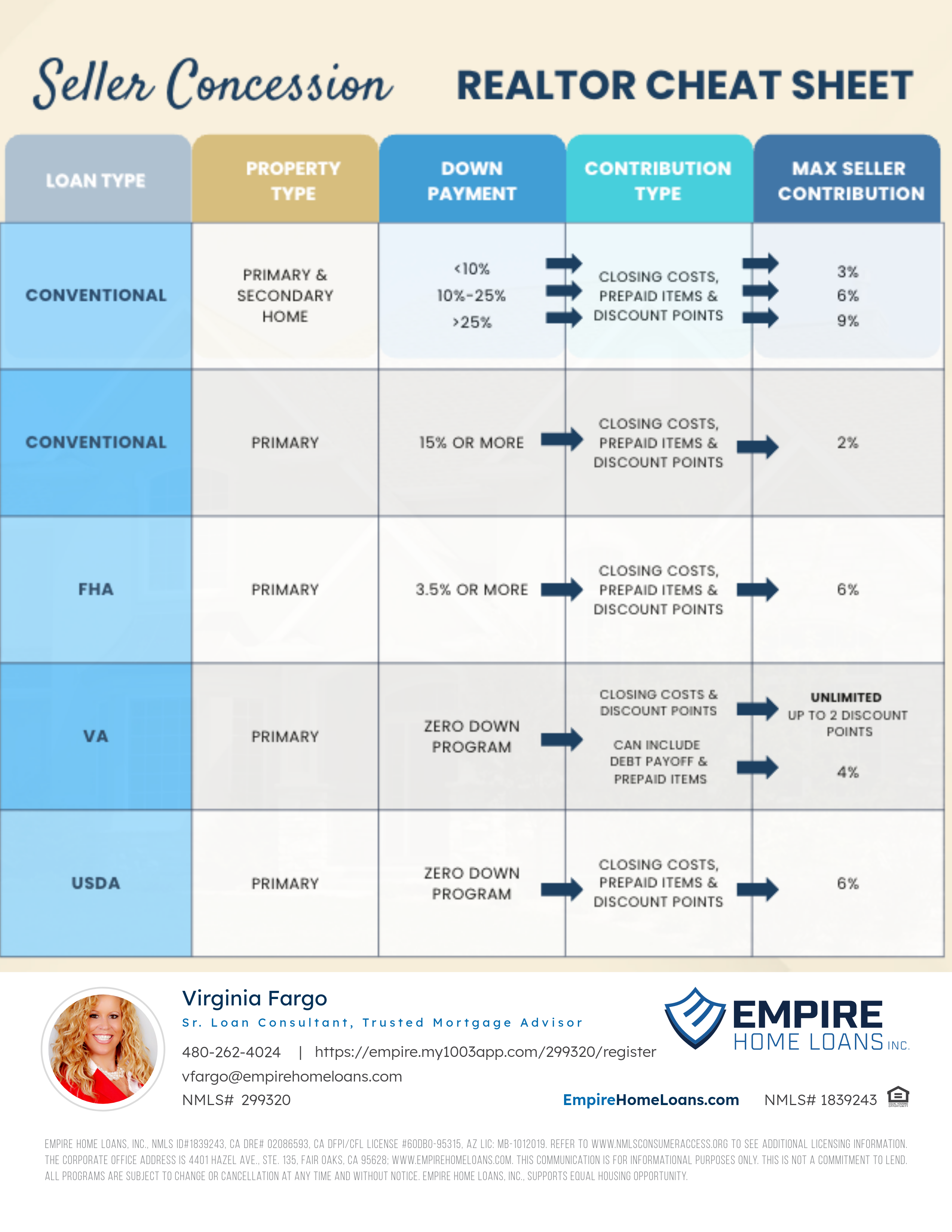
There are limits and rules surrounding seller contributions, so the amount you can actually use depends on your specific financing and transaction.
Can a Seller Credit Be Used for My Down Payment?
No. Your down payment and closing costs are two different buyer expenses.
A seller credit generally cannot satisfy your required down payment.
This is particularly important for first-time homebuyers who are trying to answer:
“How much money do I actually need to buy a home?”
Your down payment is only one piece of that calculation.
You also need to consider closing costs and other expenses associated with purchasing the home.
However, if an eligible seller credit helps cover some of those other costs, you may not have to use as much of your own savings for the overall transaction.
Can a Seller Credit Lower My Mortgage Interest Rate?
Potentially, yes.
Depending on your financing, an eligible seller credit may be used toward discount points for a permanent interest-rate buydown.
Instead of using the seller's entire concession to reduce the purchase price, some or all of the eligible credit could potentially be applied toward obtaining a lower mortgage interest rate.
A lower rate can reduce the monthly principal and interest payment for as long as you have that mortgage.
There isn't one universal formula for how much money it takes to lower an interest rate.
Mortgage pricing changes, and the cost depends on your loan program, credit profile, property and transaction.
That's why this is something I prefer to calculate before your real estate agent writes the offer.
What About a Temporary Interest-Rate Buydown?
Depending on your loan program and transaction, a seller contribution may also be used toward an eligible temporary interest-rate buydown.
For example, with a 2-1 temporary buydown, the initial payments are calculated using a rate 2 percentage points below the note rate during the first year and 1 percentage point below the note rate during the second year.
Beginning in year three, payments are based on the full note rate.
It's important to understand that a temporary buydown does not permanently change the interest rate on your mortgage.
Qualification requirements also depend on the applicable loan program.
Can the Seller Pay My Closing Costs in Arizona?
Yes, seller contributions toward eligible closing costs may be permitted.
However, there isn't one seller-credit limit that applies to every homebuyer.
Conventional, FHA, VA and USDA financing have different requirements, and allowable contributions can also depend on other details of the transaction.
That's why I don't want a buyer negotiating a seller credit simply because they saw a percentage online.
First, let's determine how much of that credit you can actually use.
Then you and your real estate agent can negotiate with real numbers.
Why Are Seller Credits Worth Discussing in Phoenix Right Now?
The Phoenix-area housing market has created negotiating opportunities for some buyers in 2026.
Realtor.com's August 2026 housing data showed that 27.6% of listings in the Phoenix-Mesa-Chandler metro had a price reduction. Active inventory was also higher than a year earlier.
That doesn't mean every seller will offer a concession or accept a lower price.
It does mean buyers should understand their options when they find a seller who is willing to negotiate.
Instead of automatically asking:
“How much can we get off the price?”
Consider asking:
“How can we structure this negotiation to help with my cash to close and monthly payment?”
Should I Ask for a Seller Credit or a Lower Price?
There isn't one answer that works for every homebuyer.
Before deciding, I want to look at three things:
1. How much money will you need at closing?
2. What monthly mortgage payment are you comfortable with?
3. How could an available seller concession be structured within your loan guidelines to support those goals?
For one buyer, reducing the sales price may make sense.
For another buyer, preserving thousands of dollars in savings may be more important.
Another buyer may prefer to use eligible seller credits toward lowering the interest rate.
We won't know until we compare the numbers.
Phoenix & Scottsdale Homebuyer Tip
If you're buying a home in Phoenix, Scottsdale or the greater Maricopa County area, don't negotiate based only on the sales price.
Before your real estate agent writes the offer, I can run different financing scenarios for you.
We can compare:
Price Reduction vs. Seller Credit vs. Interest-Rate Buydown
Then you'll know how each option could affect your cash to close and monthly mortgage payment before you decide what to ask the seller for.
Before You Ask the Seller for $10,000 Off the Price...
Let's find out what else that same $10,000 could potentially do for you.
If you're buying a home in Phoenix, Scottsdale or anywhere in Arizona, I can help you understand the numbers in plain English before you make your offer.
I'm Virginia Fargo with Empire Home Loans, and I've been helping homebuyers and homeowners navigate mortgage financing since 2011.
Have a homebuying question? Let's run the numbers.
Virginia Fargo
Empire Home Loans
NMLS #299320
About Virginia Fargo
Virginia Fargo, providing No Hassle Home Loans, the trusted mortgage consultant, home loan advisor in Scottsdale & across Maricopa County, the leading mortgage broker dedicated to helping consumers save money specializing in home loans, first-time homebuyers, relocation, affordability and self-employed borrower financing.